







What Happens to NAD+ Levels as We Age?
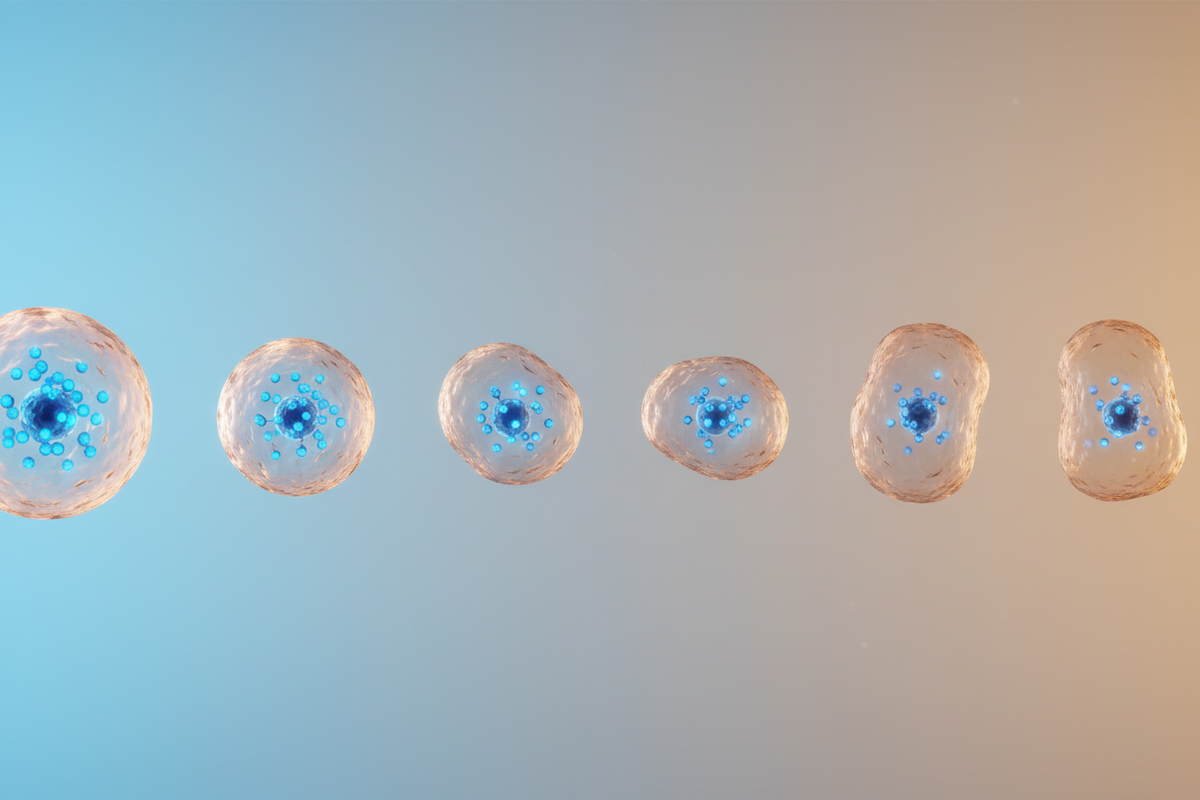
The science behind one of the most documented molecular changes in human aging.
Aging Has a Molecular Signature. NAD+ Is Part of It.
Most people think of aging in terms of what they can see — gray hair, slower recovery, less energy. But underneath those visible changes, aging is fundamentally a cellular process. And at the cellular level, one of the most consistently observed changes is a significant, progressive decline in NAD+.
This isn’t a fringe theory. It’s been measured in blood, muscle, liver, brain, and skin tissue across multiple species — including humans. The decline is real, it’s consistent, and its consequences touch nearly every major system in the body.
How Much Does NAD+ Decline With Age?
| Age Range | Estimated NAD+ Level (relative to young adult baseline) |
|---|---|
| 20s | ~100% (baseline) |
| 30s | ~80–85% |
| 40s | ~65–70% |
| 50s | ~50–55% |
| 60s | ~40–45% |
| 70s+ | ~25–35% |
Based on aggregate data from tissue and blood NAD+ measurements across published human and animal studies. Individual variation is significant.
Key finding: A landmark 2013 study in Cell by Gomes et al. found that NAD+ levels in the muscle tissue of two-year-old mice were dramatically lower than in six-month-old mice — and that this decline was directly associated with mitochondrial dysfunction. The study helped establish NAD+ decline as a driver of aging biology, not merely a side effect.
By middle age, most people have lost roughly half of their peak NAD+ capacity. By the time they reach their 70s, levels may be a quarter of what they were in young adulthood.
Why Does NAD+ Decline With Age?
The decline isn’t caused by a single factor. It’s the result of several converging biological processes that accelerate as we get older.
1. Increased PARP Consumption
DNA damage accumulates with age — from UV exposure, oxidative stress, replication errors, and environmental factors. PARP enzymes (the primary DNA repair responders) consume NAD+ every time they activate.
As DNA damage becomes more frequent and extensive with age, PARPs are activated more often, consuming larger amounts of NAD+. In periods of high damage, PARP1 alone can consume up to 80% of a cell’s NAD+ supply. The result: a growing imbalance between NAD+ consumption and the body’s ability to replenish it.
2. Rising CD38 Activity (“The NAD+ Consumer”)
CD38 is an enzyme that degrades NAD+ as part of normal cellular signaling — particularly in immune and calcium regulation. The problem is that CD38 expression increases significantly with age, driven largely by chronic low-grade inflammation (sometimes called “inflammaging”).
Research has shown that CD38 activity in aged tissues can be two to three times higher than in young tissues.
Data point: A 2016 study in Cell Metabolism (Camacho-Pereira et al.) demonstrated that CD38 knockout mice maintained significantly higher NAD+ levels into old age and were protected from many age-related metabolic declines — directly implicating CD38 as a key driver of NAD+ decline.
3. Declining Biosynthesis: The Salvage Pathway Slows Down
The body doesn’t only consume NAD+ — it also recycles it. The primary recycling mechanism is called the salvage pathway, which converts nicotinamide back into usable NAD+. The rate-limiting enzyme in this pathway is NAMPT. NAMPT activity declines with age, reducing the efficiency of NAD+ recycling. Combined with increased consumption, the effect is compounded.
4. Reduced Dietary Precursor Availability
NAD+ can also be synthesized from dietary precursors — including tryptophan, NR, and NMN. As people age, dietary patterns often shift, and the efficiency of precursor conversion can decline. This is a contributing factor, though generally considered secondary to the consumption and biosynthesis issues above.
What Does NAD+ Decline Actually Mean for the Body?
The consequences of falling NAD+ levels aren’t abstract:
- Mitochondria — Lower NAD+ means reduced electron transport chain efficiency, less ATP production, and declining cellular energy output
- DNA repair — Impaired PARP function allows DNA damage to accumulate faster, increasing genomic instability over time
- Sirtuins — Reduced NAD+ directly suppresses sirtuin activity (SIRT1–SIRT7), affecting gene regulation, inflammation control, fat metabolism, and mitochondrial quality control
- Redox balance — A declining NAD+/NADH ratio shifts cells toward a more dysfunctional metabolic state, associated with increased oxidative stress and insulin resistance
- Circadian rhythm — NAD+ metabolism is tightly coupled to the body’s internal clock via SIRT1 and NAMPT. Declining NAD+ is associated with disrupted circadian signaling, with downstream effects on sleep, hormone regulation, and metabolic timing
Is NAD+ Decline a Cause or a Consequence of Aging?
This is one of the more nuanced questions in longevity research — and the honest answer is: likely both.
NAD+ decline is partly a consequence of aging — driven by accumulated DNA damage, inflammation, and biosynthetic inefficiency. But evidence from animal studies suggests it also acts as a driver of further aging biology: restoring NAD+ in aged animals has been shown to reverse several age-related physiological deficits, not merely slow them down.
This bidirectional relationship is why NAD+ has attracted significant research interest. It sits at a potential feedback loop — where aging depletes NAD+, and NAD+ depletion accelerates aging.
Can the Decline Be Slowed or Reversed?
Lifestyle factors with documented effects on NAD+:
- Exercise — Both aerobic and resistance training upregulate NAMPT and increase NAD+ biosynthesis
- Caloric restriction / intermittent fasting — Consistently associated with higher NAD+ levels and sirtuin activation across species
- Sleep optimization — Supports circadian-regulated NAD+ replenishment cycles
- Reducing chronic inflammation — Decreases CD38 upregulation, slowing one of the primary age-related consumption drivers
NAD+ precursor supplementation:
- NMN (Nicotinamide Mononucleotide) — Multiple human trials confirm that oral NMN raises blood and muscle NAD+ levels
- NMNH (Reduced NMN) — A newer, more stable form with early evidence of faster and potentially more efficient NAD+ elevation
- NR (Nicotinamide Riboside) — Well-studied in humans; consistently shown to raise blood NAD+ levels across more than a dozen published trials
Important context: Raising NAD+ levels through supplementation is not the same as reversing aging. Human clinical evidence on functional outcomes remains preliminary and varies by population. The science is promising; it is not yet definitive.
The Bottom Line
NAD+ decline with age is one of the most consistently documented molecular changes in aging biology. It’s not a single event — it’s the cumulative result of increased consumption, reduced recycling, and declining biosynthesis, all of which accelerate as we get older.
Understanding this decline is foundational to understanding why cellular function deteriorates with age — and why supporting NAD+ levels has become one of the more scientifically grounded areas of longevity research.
This article is for informational purposes only and is not intended as medical advice. These statements have not been evaluated by the Food and Drug Administration. This product is not intended to diagnose, treat, cure, or prevent any disease. Consult a qualified healthcare provider before starting any supplement regimen.