





Urolithin A vs. Pomegranate Extract: What's the Difference?

Understanding the Connection Between Pomegranates, Gut Bacteria, and Urolithin A
Pomegranates have a pretty good reputation in the wellness world. They are rich in colorful plant compounds, their seeds add a refreshing tartness to salads and yogurt, and pomegranate juice has been studied for its polyphenol content.
So when people hear that Urolithin A is connected to pomegranates, a reasonable question comes up: Is taking pomegranate extract basically the same as taking Urolithin A?
Not quite.
The connection is real, but there is an important step between eating pomegranate and producing Urolithin A. That step happens in the gut, and it depends partly on the microorganisms living there.
Understanding the difference can make supplement labels a little easier to navigate—and help explain why two people can eat similar foods without necessarily producing the same metabolites.
Pomegranate Provides the Starting Materials
Pomegranates contain several types of polyphenols, including compounds called ellagitannins. One of the best-known ellagitannins in pomegranate is punicalagin.
When ellagitannins are consumed, they can be broken down in the digestive tract and release ellagic acid. This is where the gut microbiome becomes relevant.
Certain gut bacteria can transform ellagic acid through a series of reactions into compounds known as urolithins. Urolithin A is one of the best-studied members of this group.
You can think of it as a small chain of events:
Pomegranate → Ellagitannins → Ellagic Acid → Gut Microbial Conversion → Urolithin A
It sounds straightforward when written this way. In real life, though, not everyone's gut microbiome handles the process in the same way.
And that is the detail that makes this topic more interesting than a simple comparison between two supplement ingredients.
The Gut Microbiome Makes a Difference
Eating a food that contains the right precursor does not guarantee that your body will turn it into a particular metabolite.
Researchers have identified different patterns of urolithin production, often described as urolithin metabotypes. The commonly discussed groups include:
-
UM-A: Produces Urolithin A as the main final urolithin detected.
-
UM-B: Produces Urolithin A along with additional urolithin compounds.
-
UM-0: Does not produce the typical downstream urolithins detected in the other two groups.
These categories are not a simple ranking of gut health. They describe differences in how the gut microbiome processes ellagitannins and ellagic acid.
The practical point is that natural Urolithin A production varies from person to person. Eating more pomegranate does not necessarily solve that variation.
A small human study published in Food & Function in 2015 illustrates this well. Twenty healthy participants consumed 1,000 mg of pomegranate extract daily for four weeks. The researchers observed three response patterns: some participants began producing detectable Urolithin A, some already produced it and showed an increase, while others did not show detectable production even after the intervention.
This was a small study, so it cannot tell us exactly how everyone will respond to pomegranate. But it does show why the phrase "pomegranate contains Urolithin A" is not quite accurate. Pomegranate contains precursors that certain gut microbes can convert into Urolithin A.
So, Is Pomegranate Extract the Same as Urolithin A?
No. They are related, but they are different compounds with different roles in the process.
Pomegranate extract generally provides plant compounds such as ellagitannins and ellagic acid. The exact amounts depend on the source material, extraction method, and product standardization.
Urolithin A supplements provide Urolithin A itself as the featured ingredient, rather than relying on the body to create it from dietary precursors.
That distinction matters when comparing labels.
A bottle labeled "pomegranate extract" does not automatically tell you how much Urolithin A your body will produce. In many cases, it does not contain a meaningful amount of preformed Urolithin A at all. You would need to look at the actual ingredient specifications and testing information rather than assume the two names are interchangeable.
The same goes for a product that advertises ellagic acid or punicalagins. These may be useful indicators of what the extract contains, but they are not the same as a declared amount of Urolithin A.
What Happens When Researchers Compare Pomegranate With Direct Urolithin A?
There is some human research looking directly at this question.
A 2021 study published in the European Journal of Clinical Nutrition examined Urolithin A production after participants consumed pomegranate juice. It also compared that dietary exposure with a 500 mg Urolithin A-containing product.
Among the 100 healthy participants, only a portion converted the pomegranate precursors into Urolithin A at higher levels. The researchers reported that direct Urolithin A intake produced more than six times the exposure measured after pomegranate juice in that study.
That finding is useful, but it needs context.
The study was designed to examine differences in Urolithin A exposure and the effect of gut microbiome variability. It was not a long-term trial proving that direct supplementation leads to better health outcomes than eating pomegranates. Higher measured exposure is not the same thing as a demonstrated clinical benefit.
Still, it helps explain why direct Urolithin A supplementation has become a separate area of research. It provides the compound without depending on the same microbial conversion step.
Which One Should You Choose?
Honestly, this does not have to be an either-or decision.
Pomegranates are nutritious foods. They provide fiber when eaten whole, along with a variety of plant compounds. Pomegranate extract may appeal to people who want a concentrated source of selected pomegranate constituents.
Direct Urolithin A supplementation is a different option for people interested in the research on Urolithin A itself.
The choice depends on what you are looking for:
Choose whole pomegranate as part of your diet if you enjoy it and want to include more fruit and plant diversity in your meals. There is no need to turn every healthy food into a supplement comparison.
Consider pomegranate extract when you are specifically interested in a concentrated pomegranate ingredient. Check the label for standardization details, such as punicalagin or ellagic acid content, and remember that precursor content does not guarantee Urolithin A production.
Look at direct Urolithin A products when your interest is specifically in Urolithin A supplementation. Check how much Urolithin A is provided per daily serving, whether the amount is clearly disclosed, and what quality information the brand makes available.
One point is worth repeating: more is not automatically better, and a supplement should not replace a varied diet or appropriate medical care.
A Closer Look at the inGreens Urolithin A Complex
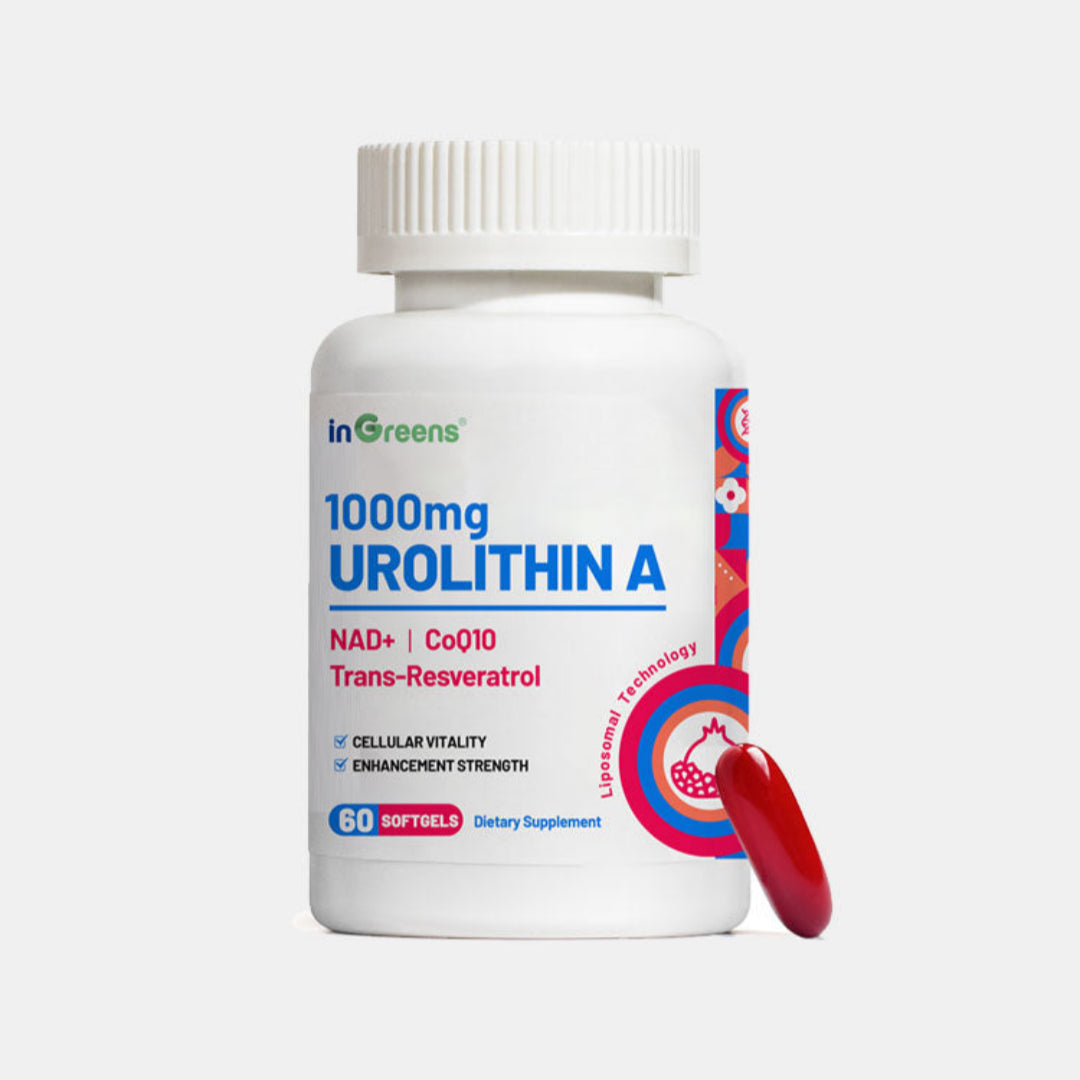
For readers who want to explore a formula featuring Urolithin A directly, the inGreens Urolithin A Complex takes a multi-ingredient approach.
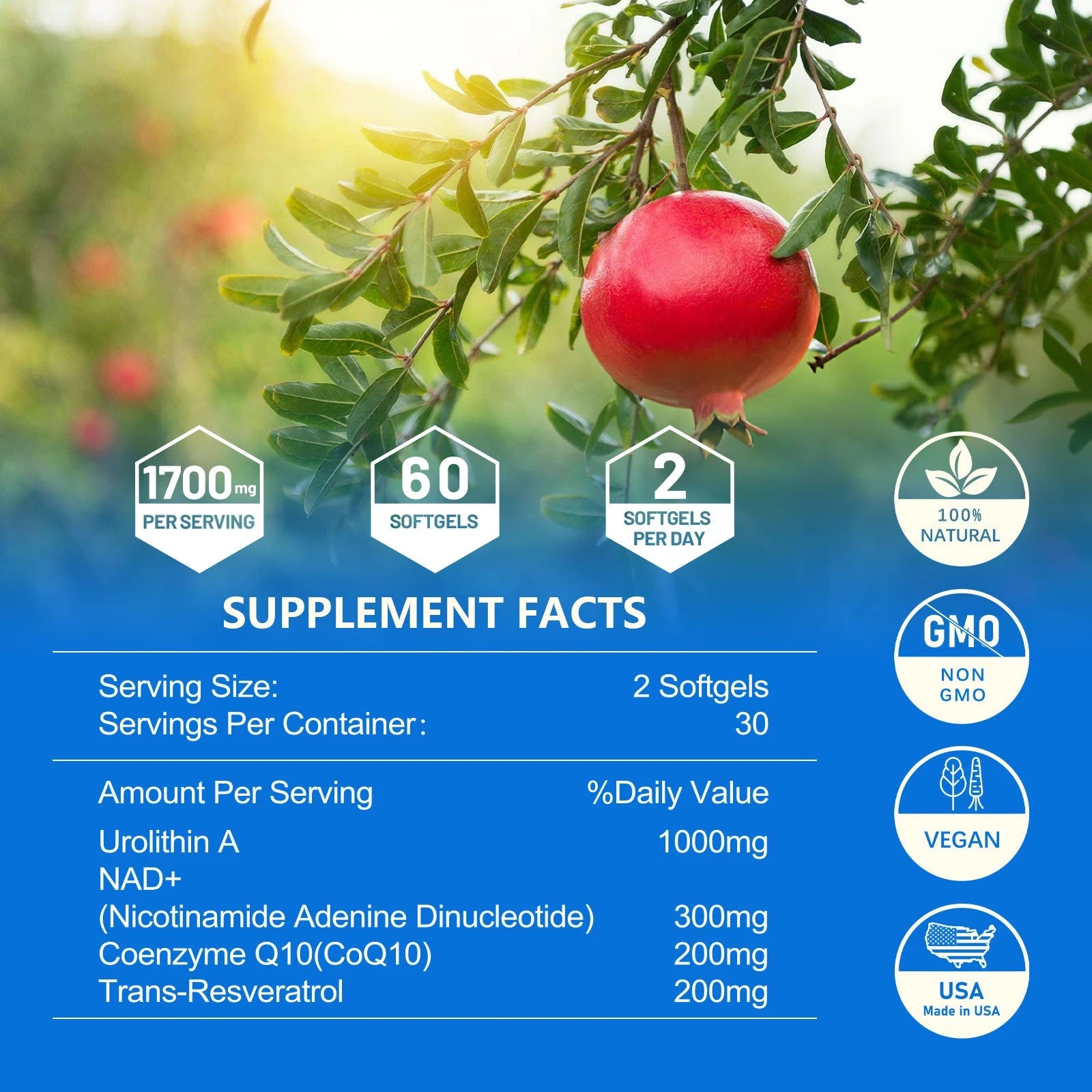
Each serving of two softgels provides:
| Featured Ingredient | Amount Per Serving |
|---|---|
| Urolithin A | 1,000 mg |
| NAD+ | 300 mg |
| CoQ10 | 200 mg |
| Trans-Resveratrol | 200 mg |
The bottle contains 60 softgels, or 30 servings. The suggested use is two softgels daily, with or without food.
The main distinction from a pomegranate extract is that this formula lists Urolithin A itself as a featured ingredient. It does not rely on your gut microbiome to produce that ingredient from pomegranate-derived precursors.
The formula also includes NAD+, CoQ10, and trans-resveratrol, which are studied in different areas of cellular metabolism and nutrition research. Their inclusion does not, by itself, prove that the finished combination produces a synergistic effect.
You can review the ingredient amounts and full product details here:
Explore inGreens Urolithin A Complex
A Few Things Worth Keeping in Mind
The relationship between pomegranates and Urolithin A is a good example of how food compounds interact with the gut microbiome. A food can provide the starting materials, while gut bacteria determine which metabolites are produced and in what amounts.
That does not make pomegranates less valuable, and it does not mean everyone needs a Urolithin A supplement. They are simply different ways of approaching a related area of nutrition and research.
If you enjoy pomegranates, keep enjoying them. If you are comparing supplements, read the ingredient panel carefully and distinguish between a precursor extract and Urolithin A itself.
Knowing what is actually in the bottle is a much better starting point than relying on a familiar fruit name on the front label.
References
-
Li Z, Henning SM, Lee RP, et al. (2015). Pomegranate extract induces ellagitannin metabolite formation and changes stool microbiota in healthy volunteers. Food & Function, 6, 2487–2495. https://doi.org/10.1039/C5FO00669D
-
Andreux PA, Blanco-Bose W, Rinsch C, Auwerx J. (2022). Direct supplementation with Urolithin A overcomes limitations of dietary exposure and gut microbiome variability in healthy adults to achieve consistent levels across the population. European Journal of Clinical Nutrition. https://doi.org/10.1038/s41430-021-00950-1
-
García-Villalba R, Giménez-Bastida JA, Cortés-Martín A, et al. (2022). Urolithins: a Comprehensive Update on their Metabolism, Bioactivity, and Associated Gut Microbiota. Molecular Nutrition & Food Research, 66(21), e2101019. https://doi.org/10.1002/mnfr.202101019
-
Cortés-Martín A, Iglesias-Aguirre CE, Marín A, et al. (2024). Urolithin A production drives the effects of pomegranate on the gut microbial metabolism of bile acids and cholesterol in mild dyslipidaemic overweight and obese individuals. Food & Function, 15, 2422–2432. https://doi.org/10.1039/D3FO05014A
Disclaimer: This article is for educational purposes only and is not intended to provide medical advice. These statements have not been evaluated by the Food and Drug Administration. This product is not intended to diagnose, treat, cure, or prevent any disease.