





The Gut Microbiome and Urolithin A: Why Natural Production Varies

How Your Gut Bacteria Influence the Way Your Body Processes Plant Compounds
Two people can eat the same foods, follow fairly similar diets, and still process certain nutrients quite differently. The gut microbiome is one reason why.
Urolithin A is a particularly interesting example. It is a compound that your body can produce with help from gut bacteria after you consume certain plant-based foods, including pomegranates, walnuts, and some berries.
You might assume that eating more of these foods would naturally lead to more Urolithin A. But the research tells a more complicated story. Some people produce measurable amounts, while others produce very little or none that can be detected.
It isn't necessarily about who eats better. The difference has a lot to do with the microorganisms living in the digestive tract and what they are capable of doing.
Your Gut Bacteria Do More Than Help With Digestion
Most people associate gut bacteria with digestion, regularity, or probiotics. Those are certainly important parts of the conversation, but the gut microbiome also helps process compounds found in food.
Polyphenols are a good example. These naturally occurring plant compounds are found in fruits, vegetables, nuts, tea, and many other foods. Some are absorbed relatively early during digestion, while others travel farther through the digestive system and are transformed by gut microbes.
Urolithin A comes from this second group.
Pomegranates and walnuts contain ellagitannins, which can be broken down into ellagic acid during digestion. Certain gut bacteria then help transform ellagic acid through several metabolic steps, eventually producing urolithins, including Urolithin A.
The process looks simple on paper:
Ellagitannins → Ellagic Acid → Gut Microbial Metabolism → Urolithin A
In reality, several microbial reactions are involved. Researchers have identified bacteria such as Gordonibacter urolithinfaciens and Ellagibacter isourolithinifaciens that can participate in urolithin production.
This doesn't mean that having one particular bacterial species automatically makes someone a Urolithin A producer. The process involves a broader microbial community, and different bacteria can contribute to different stages of the metabolic pathway.
That is where individual differences begin to matter.
Why Two People Can Produce Different Amounts
Think about two people who regularly eat pomegranate. One may produce detectable Urolithin A after consuming ellagitannin-rich foods, while the other may produce very little.
Their diets could be quite similar. The difference may come down to the composition and metabolic activity of their gut microbiomes.
Researchers have identified three commonly discussed urolithin metabotypes, which describe different patterns of urolithin production.
UM-A:
People in this group primarily produce Urolithin A as their final detectable urolithin metabolite.
UM-B:
This group produces Urolithin A along with other urolithins, particularly isourolithin A and/or Urolithin B.
UM-0:
People in this group do not produce the typical final urolithins at detectable levels following dietary precursor intake. Intermediate compounds may still be present.
These classifications are based on measured metabolite patterns after consuming relevant dietary compounds. They are not grades of gut health, and UM-0 does not automatically mean someone has an unhealthy digestive system.
A 2014 human research paper documented these three patterns across different dietary intervention studies. Interestingly, the differences were observed after consumption of several ellagitannin-rich foods, including pomegranates, walnuts, strawberries, and other berries.
In other words, simply switching from one source of ellagitannins to another does not necessarily overcome individual differences in microbial metabolism.
What Human Research Has Found
One study that helps put these differences into perspective was published in the European Journal of Clinical Nutrition in 2021.
Researchers studied 100 healthy American adults between the ages of 20 and 80. Participants consumed pomegranate juice to assess their natural ability to produce Urolithin A. The study also compared dietary exposure with direct Urolithin A supplementation.
The results were interesting.
Only 12% of participants had detectable Urolithin A levels at baseline. After consuming pomegranate juice, approximately 40% showed significant conversion of the dietary precursor compounds into Urolithin A.
The researchers also found differences in gut microbial diversity between producers and non-producers.
When participants received 500 mg of Urolithin A directly, circulating exposure was more than six times higher than after pomegranate juice consumption in the study.
This was not a trial showing that supplementation produces six times better health outcomes. It measured differences in Urolithin A exposure. That distinction matters.
Still, the findings help explain why eating foods containing ellagitannins does not guarantee a consistent amount of Urolithin A for everyone.
The study also showed that age alone did not explain who produced Urolithin A. Participants across different age groups demonstrated variability.
Can You Change Your Natural Urolithin A Production?
This is probably the question most people have after learning about metabotypes.
If gut bacteria influence Urolithin A production, can you simply improve your microbiome and become a better producer?
The honest answer is that researchers are still investigating this.
A diverse eating pattern that includes fiber-rich plant foods can support a healthy gut environment. Vegetables, fruits, legumes, whole grains, nuts, and seeds all provide different types of dietary fiber and plant compounds.
Pomegranates, walnuts, and berries are particularly relevant here because they contain ellagitannins or related precursors involved in urolithin production.
However, eating more of these foods does not guarantee that your microbiome will produce more Urolithin A.
It is also worth being cautious about products marketed as microbiome boosters specifically for Urolithin A production. There is not yet enough human evidence to recommend a particular probiotic, prebiotic, or dietary routine as a reliable way to turn every non-producer into a producer.
The gut microbiome is a complex ecosystem. Its activity is influenced by multiple factors, including dietary patterns, physiology, health status, and other characteristics of the individual.
Rather than chasing one particular bacterial species, a varied and sustainable eating pattern is a more sensible foundation for everyday gut health.
Does a Gut Microbiome Test Tell You If You Produce Urolithin A?
Not necessarily.
Many commercial gut microbiome tests provide information about bacterial composition. They may identify certain bacterial groups and offer general observations about microbial diversity.
But identifying bacteria in a stool sample is not the same as measuring their ability to produce a specific metabolite.
In research settings, urolithin metabotypes are generally identified by measuring urolithin metabolites after exposure to ellagitannin-rich foods or other relevant precursors.
A general microbiome report should therefore not be treated as a definitive answer to whether you naturally produce Urolithin A.
This is an important distinction because the presence of a particular bacterial species does not always tell us how actively the complete microbial community is performing a metabolic process.
Why Direct Urolithin A Supplementation Is Being Studied
The variability in natural production is one reason researchers have become interested in direct Urolithin A supplementation.
Instead of depending on gut bacteria to convert dietary precursors, direct supplementation provides Urolithin A itself.
That makes it possible to study a more defined intake of the compound across people with different microbiome profiles.
Researchers are particularly interested in Urolithin A because of its relationship with mitophagy, the cellular process involved in identifying and recycling damaged mitochondria.
This process is part of the body's normal cellular maintenance system. Urolithin A has shown interesting results in laboratory research, and human trials have begun exploring its effects on selected mitochondrial biomarkers and measures of muscle function.
However, the research is still developing. A more consistent intake of Urolithin A does not automatically mean everyone will experience the same physical or health outcomes.
For a broader look at how the ingredient is being studied, see our article on Urolithin A and Mitochondrial Health.
Exploring the inGreens Urolithin A Complex
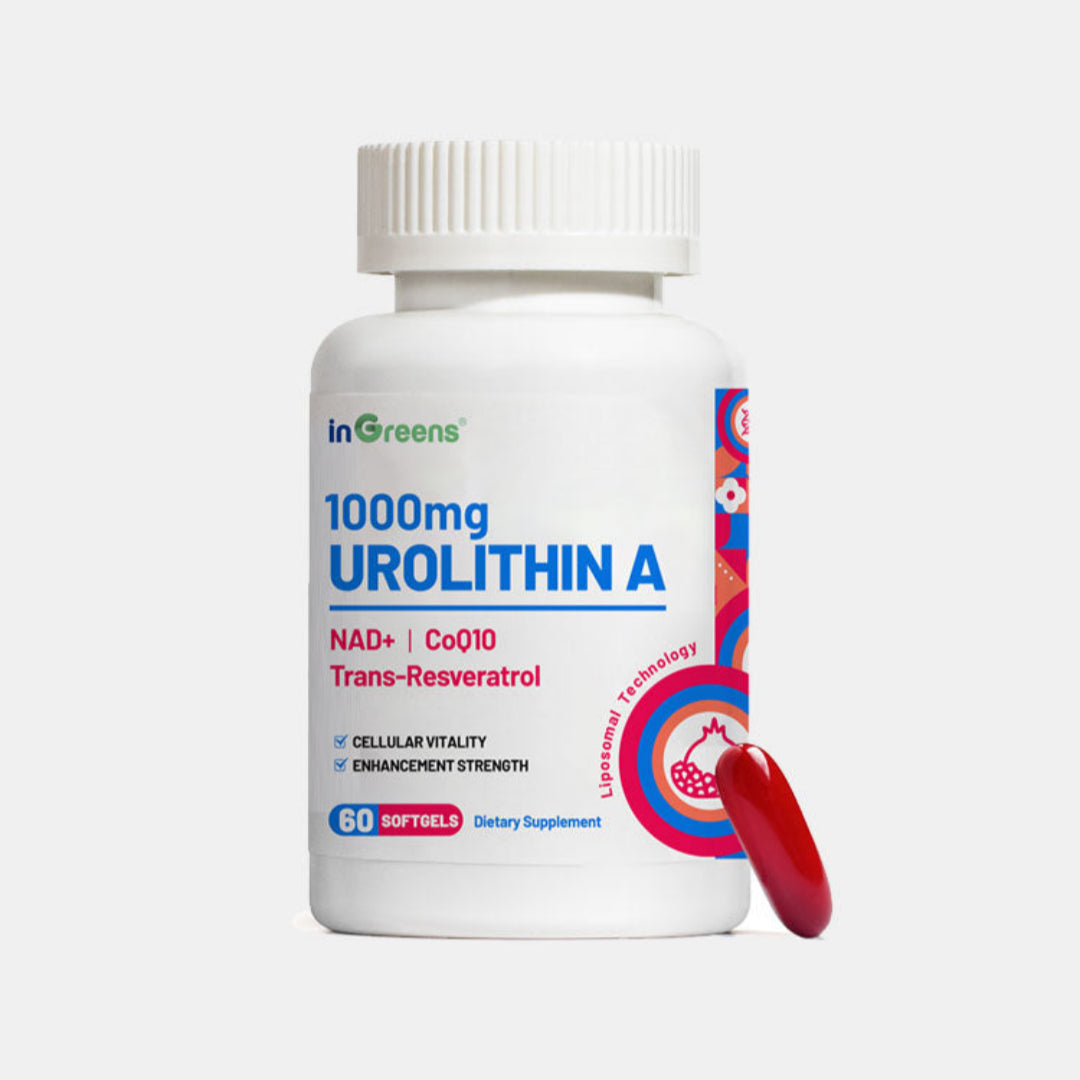
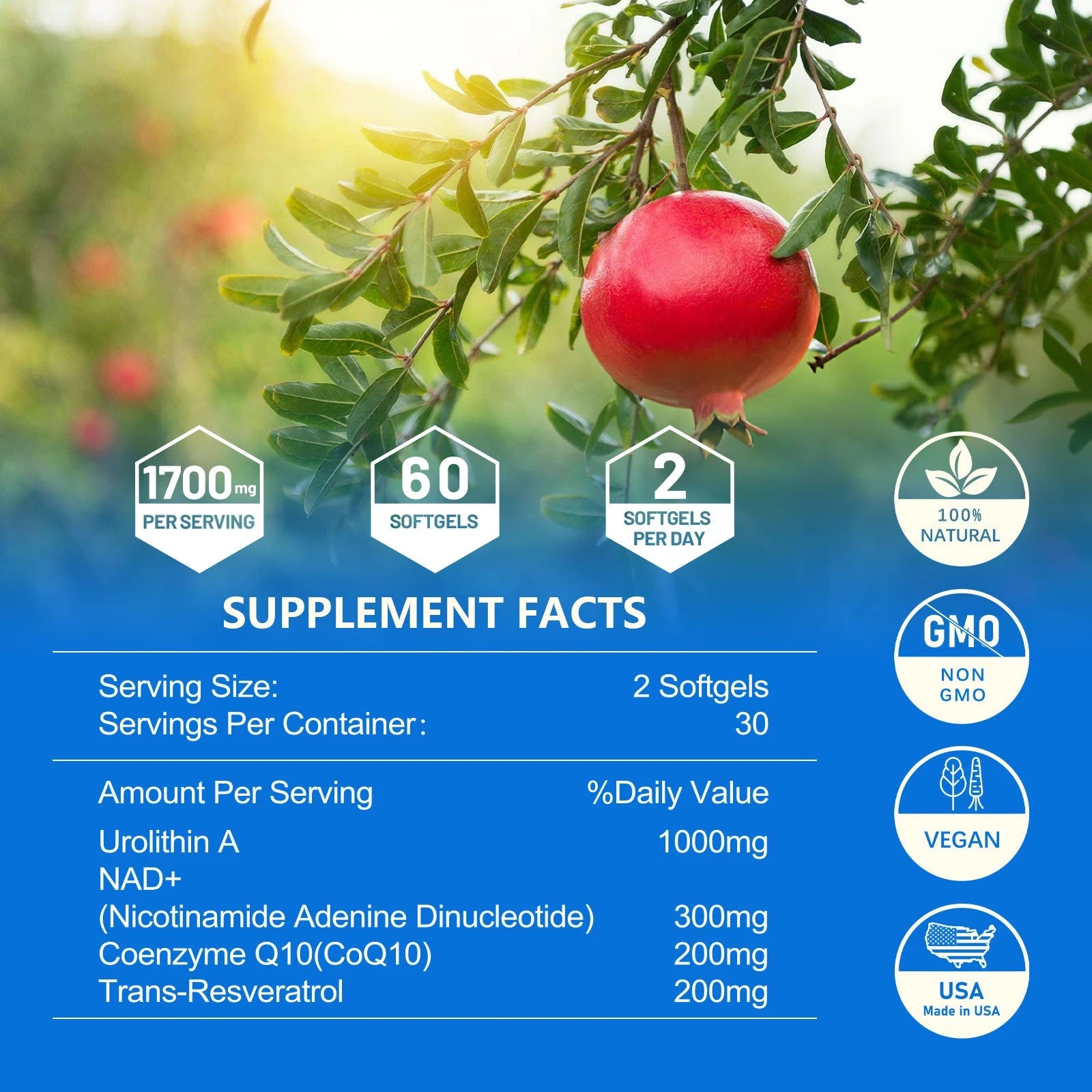
For adults interested in direct Urolithin A supplementation, the inGreens Urolithin A Complex offers a four-ingredient softgel formula.
Each two-softgel serving contains:
| Ingredient | Amount Per Serving |
|---|---|
| Urolithin A | 1,000 mg |
| NAD+ | 300 mg |
| CoQ10 | 200 mg |
| Trans-Resveratrol | 200 mg |
The formula provides Urolithin A directly, rather than relying on the gut microbiome to convert pomegranate-derived precursors.
NAD+, CoQ10, and trans-resveratrol are included as additional ingredients with their own areas of cellular and nutritional research.
The bottle contains 60 softgels, providing 30 servings. The suggested use is two softgels daily, with or without food.
It is worth keeping the research in perspective: human clinical trials discussed in the Urolithin A literature have generally investigated the individual Urolithin A ingredient. Those findings should not be interpreted as clinical validation of the complete four-ingredient inGreens formula.
You can find the full ingredient details here:
Explore inGreens Urolithin A Complex
A Little More Perspective on Gut Health
The gut microbiome is fascinating partly because it helps explain why nutrition is not always as straightforward as looking at an ingredient list.
Two people can eat the same foods and process certain plant compounds differently. Urolithin A gives researchers a useful example of that relationship between diet, gut bacteria, and human metabolism.
If you enjoy pomegranates, berries, and walnuts, there are plenty of good reasons to keep them in your diet. You don't need to measure every meal by how much Urolithin A it might produce.
And if you're interested in Urolithin A itself, understanding the difference between natural production and direct supplementation can help you make a more informed decision.
Sometimes, the most useful thing nutrition research can do is explain why the same advice doesn't produce exactly the same biological response in everyone.
References
-
Tomás-Barberán FA, García-Villalba R, González-Sarrías A, et al. (2014). Ellagic Acid Metabolism by Human Gut Microbiota: Consistent Observation of Three Urolithin Phenotypes in Intervention Trials, Independent of Food Source, Age, and Health Status. Journal of Agricultural and Food Chemistry, 62(28), 6535–6538. DOI: 10.1021/jf5024615.
-
Andreux PA, Blanco-Bose W, Rinsch C, Auwerx J. (2022). Direct Supplementation with Urolithin A Overcomes Limitations of Dietary Exposure and Gut Microbiome Variability in Healthy Adults to Achieve Consistent Levels Across the Population. European Journal of Clinical Nutrition. DOI: 10.1038/s41430-021-00950-1.
-
García-Villalba R, Giménez-Bastida JA, Cortés-Martín A, et al. (2022). Urolithins: A Comprehensive Update on Their Metabolism, Bioactivity, and Associated Gut Microbiota. Molecular Nutrition & Food Research, 66(21), 2101019. DOI: 10.1002/mnfr.202101019.
-
García-Villalba R, Beltrán D, et al. (2020). Metabolism of Different Dietary Phenolic Compounds by the Urolithin-Producing Human-Gut Bacteria Gordonibacter urolithinfaciens and Ellagibacter isourolithinifaciens. Food & Function, 11, 7012–7022. DOI: 10.1039/D0FO01649G.
Disclaimer: This article is for educational purposes only and is not intended to provide medical advice. These statements have not been evaluated by the Food and Drug Administration. This product is not intended to diagnose, treat, cure, or prevent any disease.