





Urolithin A and Muscle Health: What Human Research Has Explored

Have you ever noticed that a workout that felt relatively easy a few years ago now takes a little more effort? Maybe it's climbing a long flight of stairs, carrying groceries, or getting through a strength-training session without feeling quite as tired afterward.
Muscle health is something many of us don't think about until we notice a change. And while most conversations about maintaining muscle focus on protein, resistance training, and recovery, researchers are also looking at something happening inside muscle cells: mitochondrial health.
That's where Urolithin A has entered the conversation.
Urolithin A is a compound produced by certain gut bacteria when they break down plant compounds found in foods such as pomegranates and walnuts. Scientists have been studying it for its potential relationship with mitophagy, the cellular process responsible for identifying and recycling damaged mitochondria.
The interesting question is whether those findings translate into measurable changes in human muscle function. There are now several clinical trials worth looking at, although the overall evidence is still developing.
Why Are Researchers Interested in Mitochondria and Muscle?
Muscle cells rely heavily on mitochondria to produce the energy needed for movement and physical activity.
Whether you're walking, lifting weights, cycling, or simply getting through a busy day, your muscles need a steady supply of usable energy. As we age, changes in mitochondrial function and cellular maintenance may contribute to reduced muscle performance.
This is one reason researchers are exploring ways to maintain mitochondrial quality.
Urolithin A is particularly interesting because laboratory and animal studies suggest it may influence mitophagy. Rather than simply focusing on producing more cellular energy, this research looks at how cells identify and recycle mitochondria that are no longer functioning properly.
It's a promising area of research, but laboratory findings alone cannot tell us whether taking Urolithin A will make someone stronger or improve everyday physical performance.
For that, we need human studies.
What Happened in the First Major Muscle Health Trial?
One of the most frequently discussed studies was published in JAMA Network Open in January 2022.
Researchers recruited 66 adults between the ages of 65 and 90 and randomly assigned them to receive either 1,000 mg of Urolithin A daily or a placebo for four months.
The researchers looked at several outcomes, including:
- Muscle endurance in the hand and leg.
- Six-minute walking distance.
- Maximum ATP production in skeletal muscle.
- Blood biomarkers associated with mitochondrial and cellular health.
Some of the findings were encouraging.
Participants receiving Urolithin A showed improvements in muscle endurance measurements. Specifically, researchers observed an increase in the number of repeated muscle contractions participants could perform before reaching fatigue.
However, there is an important detail that often gets lost when this study is discussed.
The improvements in the primary outcomes—the six-minute walking distance and maximum ATP production—were not statistically significant compared with placebo.
The muscle endurance improvements were also more evident at the two-month assessment than at the four-month endpoint.
So while the study offered an interesting signal, it did not demonstrate that Urolithin A consistently improved every measure of physical function.
You can read the original study in JAMA Network Open.
What About Middle-Aged Adults?
A second important study, published in Cell Reports Medicine in May 2022, looked at a different group.
This trial included 88 overweight, untrained adults between 40 and 64 years old. Participants received 500 mg of Urolithin A, 1,000 mg of Urolithin A, or a placebo daily for four months.
Researchers evaluated muscle strength, aerobic endurance, walking performance, and several mitochondrial-related biomarkers.
One notable finding was an improvement in selected leg muscle strength measurements, particularly hamstring strength, compared with placebo.
Some aerobic performance measurements also moved in a favorable direction. However, not every result reached statistical significance.
For example, the study's primary endpoint, peak power output, did not show a significant improvement compared with placebo.
Hand-grip strength also did not reach conventional statistical significance.
This distinction matters because muscle strength, aerobic capacity, and peak power are different measurements. Improvement in one does not automatically mean improvement in all the others.
Still, the study added another piece of human evidence suggesting that Urolithin A deserves further investigation in relation to muscle function.
The full study is available in Cell Reports Medicine.
Does Urolithin A Help People Who Already Exercise?
More recent research has started exploring physically active populations.
A small 2024 randomized trial involving 20 resistance-trained male athletes investigated 1,000 mg of Urolithin A daily over eight weeks.
Researchers examined several strength and exercise-related measurements, including maximal voluntary isometric contraction and repetitions performed before fatigue.
Some results favored Urolithin A, including selected measures of muscular endurance and contraction strength. However, the study did not find significant improvements in every resistance-training measurement, including bench-press and squat performance.
Other small studies have examined endurance runners and competitive soccer players.
These studies are interesting because they move beyond sedentary or middle-aged participants. At the same time, the populations are highly specific, sample sizes are small, and the results cannot automatically be applied to recreational exercisers or the general population.
A supplement that produces an interesting result in a small group of trained athletes has not necessarily been proven to improve everyday exercise performance.
What Does the Latest Research Review Say?
This is where the picture becomes particularly interesting.
In July 2026, a systematic review and meta-analysis published in Frontiers in Nutrition examined randomized controlled trials investigating Urolithin A and muscle-related outcomes.
The researchers included five trials involving a total of 236 participants. The studies covered different populations, including older adults, middle-aged adults, and physically active individuals.
The results were mixed.
Some individual trials reported improvements in selected measures of muscle strength and endurance. However, the researchers found that the outcome measurements differed too much across studies to combine most of them into a meaningful pooled analysis.
The six-minute walk test was the only outcome that could be quantitatively analyzed across two trials.
The pooled result showed an average difference of approximately 17 meters in favor of Urolithin A, but this difference was not statistically significant (p = 0.135). The researchers also rated the certainty of evidence for this outcome as low.
Another interesting finding was that the available evidence did not demonstrate an improvement in lean body mass.
In other words, the current research offers some encouraging signals around selected muscle-strength and endurance measurements, but it does not establish that Urolithin A builds muscle, prevents muscle loss, or reliably improves physical performance.
The authors concluded that larger, longer, and more standardized clinical trials are needed.
This 2026 review is particularly useful because it brings several individual studies together and gives readers a more balanced picture of what researchers actually know.
Read the 2026 systematic review in Frontiers in Nutrition.
Muscle Health Is Still About More Than One Ingredient
It is easy to get caught up in a new ingredient when the science sounds promising. But muscle health is influenced by several things working together.
Regular resistance training remains one of the most practical ways to maintain strength. Adequate protein intake provides the building blocks muscles need, while sleep and recovery help the body adapt to physical activity.
Nutrition also matters beyond protein alone. A varied diet provides vitamins, minerals, healthy fats, and other nutrients involved in normal muscle function.
Urolithin A research adds another interesting area to this conversation: mitochondrial maintenance.
It is worth viewing it as an emerging research topic rather than a replacement for established habits.
If you're already following a regular exercise routine, maintaining balanced nutrition, and prioritizing recovery, those foundations remain important regardless of whether you choose to explore additional supplements.
Exploring the inGreens Urolithin A Complex
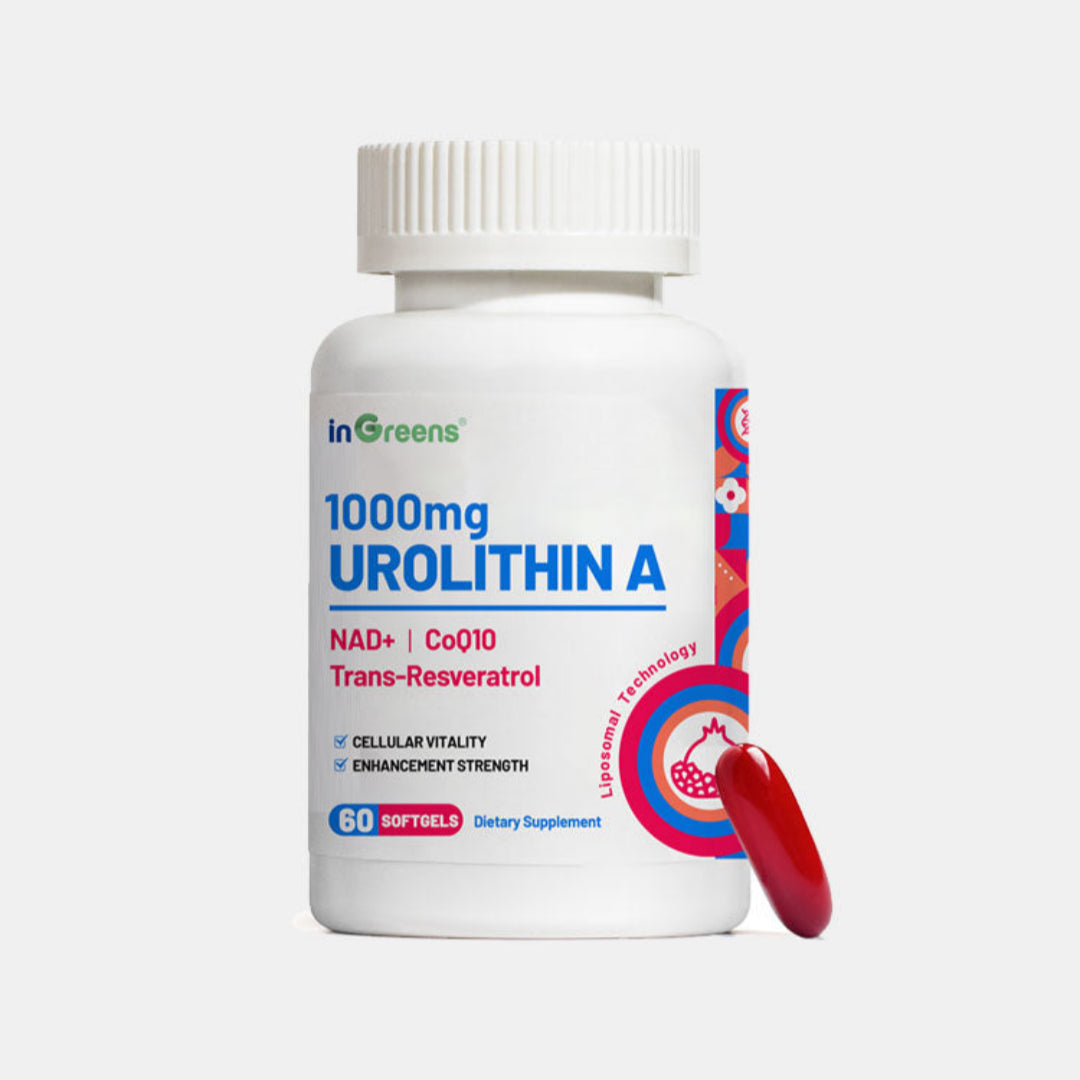
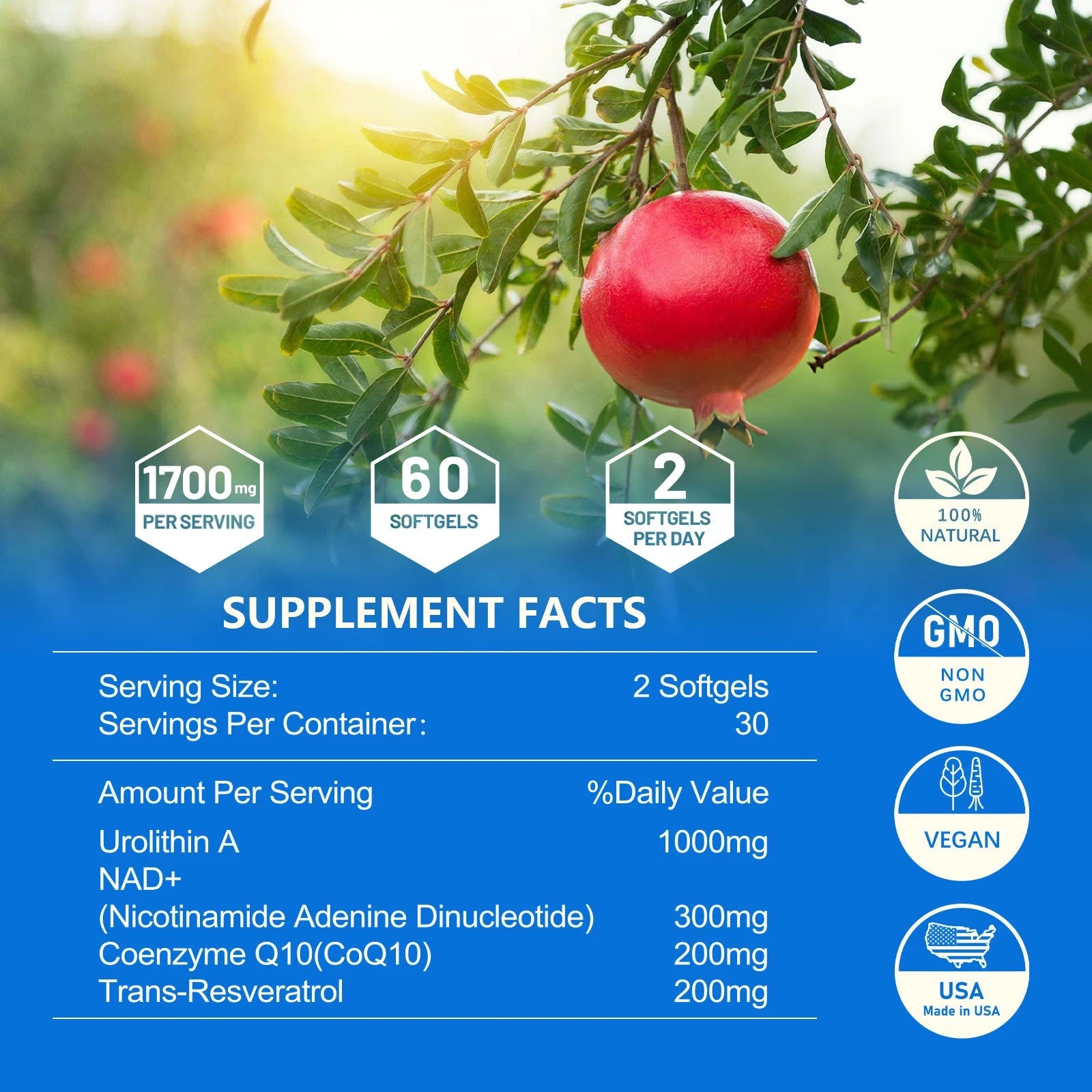
For adults interested in Urolithin A supplementation, the inGreens Urolithin A Complex combines four featured ingredients in a convenient daily softgel formula.
Each two-softgel serving provides:
| Ingredient | Amount Per Serving |
|---|---|
| Urolithin A | 1,000 mg |
| NAD+ | 300 mg |
| CoQ10 | 200 mg |
| Trans-Resveratrol | 200 mg |
Urolithin A is the primary ingredient of interest in the mitochondrial maintenance research discussed throughout this article.
NAD+, CoQ10, and trans-resveratrol are included as additional ingredients with their own areas of cellular and nutritional research.
The bottle contains 60 softgels, providing 30 servings. The suggested use is two softgels daily, with or without food.
One distinction is worth keeping in mind: the human trials discussed above investigated Urolithin A as an individual ingredient. They do not establish the clinical effectiveness of the complete four-ingredient inGreens formula.
If you're interested in reviewing the ingredients and serving details, you can find the complete product information here:
Explore inGreens Urolithin A Complex
Where Does the Research Go From Here?
There is a reason Urolithin A continues to attract attention in the healthy-aging and muscle-health research community.
The underlying biology is interesting, and several human trials have reported improvements in selected measurements of muscle strength or endurance.
But there is still a considerable gap between an encouraging research finding and a proven everyday benefit.
We need larger studies, longer follow-up periods, more diverse participants, and consistent ways of measuring muscle function. Researchers also need to establish whether the changes observed in clinical testing translate into meaningful improvements in everyday activities.
For now, the most reasonable approach is to appreciate what the science has discovered without getting ahead of it.
Staying strong and active involves many small decisions over time. Urolithin A may eventually have a clearer role in that conversation, but the research is still unfolding.