





Creatine Gummies vs. Powder: Which Is Better?

Creatine is one of those supplements that sounds simple until you start shopping for it. A quick search brings up tubs of powder, flavored drink mixes, capsules, chews, and increasingly, creatine gummies.
At first glance, the choice seems mostly about convenience. Powder is what most people associate with creatine, while gummies look like an easier option for anyone who doesn't enjoy mixing supplements into a drink.
But does the format actually matter? Are gummies as effective as powder? And what should you look for before buying either one?
The most useful way to compare them is to look beyond the packaging. The important questions are how much actual creatine you get, which form is used, how the product is made, and whether the serving fits your routine.
Does Creatine Work Differently in Gummies and Powder?
Creatine monohydrate is the form with the strongest research background. It has been studied extensively for its role in increasing muscle creatine stores and supporting repeated high-intensity exercise.
The molecule itself does not become a different nutrient simply because it is delivered in a gummy rather than a scoop of powder.
In principle, if two products provide the same amount of intact creatine monohydrate and are properly formulated, the delivery format alone should not make one inherently more effective.
However, there is an important distinction between the scientific evidence for creatine monohydrate and the evidence for individual gummy products.
Most of the major creatine research has used creatine monohydrate powder. That does not mean gummies cannot work. It means you should not assume every gummy product delivers the same amount, stability, or quality as the powder used in research.
The product's actual formulation matters.
Creatine Powder: The Traditional Option
There is a reason creatine powder has been around for so long.
It is straightforward, widely studied, and generally offers a flexible way to adjust serving size. Plain creatine monohydrate powder usually contains very few ingredients, making it easier to see exactly what you are taking.
Here are some of its main advantages.
1. Easy to measure
A powder product can provide a clearly stated amount of creatine per scoop or measured serving. If you want to follow a specific intake plan, this can be convenient.
Always check the label, though. Scoop size and serving weight are not automatically the same thing as the amount of creatine monohydrate.
2. Often more economical
Powder is generally the more cost-effective option when you compare the price per gram of actual creatine monohydrate.
For someone who takes creatine every day and does not mind mixing it into water or another drink, this can make a difference over time.
3. A simple ingredient list
Unflavored creatine monohydrate powder often has a very short ingredient list. That makes it easier to compare products and avoid unnecessary extras.
There are a few trade-offs. Some people dislike the texture, find that it does not dissolve completely, or simply do not enjoy preparing another drink every day.
Creatine monohydrate is not highly soluble in room-temperature water, so a little sediment is not necessarily a sign that something is wrong.
Creatine Gummies: A More Convenient Format
Gummies offer a different experience.
They are portable, require no shaker bottle, and can be easier to include in a daily routine. For people who dislike powder or regularly forget to prepare it, that convenience may be meaningful.
But gummies also introduce a few things worth checking.
1. How much creatine is actually in one serving?
This is the biggest question.
A gummy serving may weigh several grams because it includes the gummy base, flavoring, sweeteners, and other ingredients. That total serving weight is not the same as the amount of creatine monohydrate.
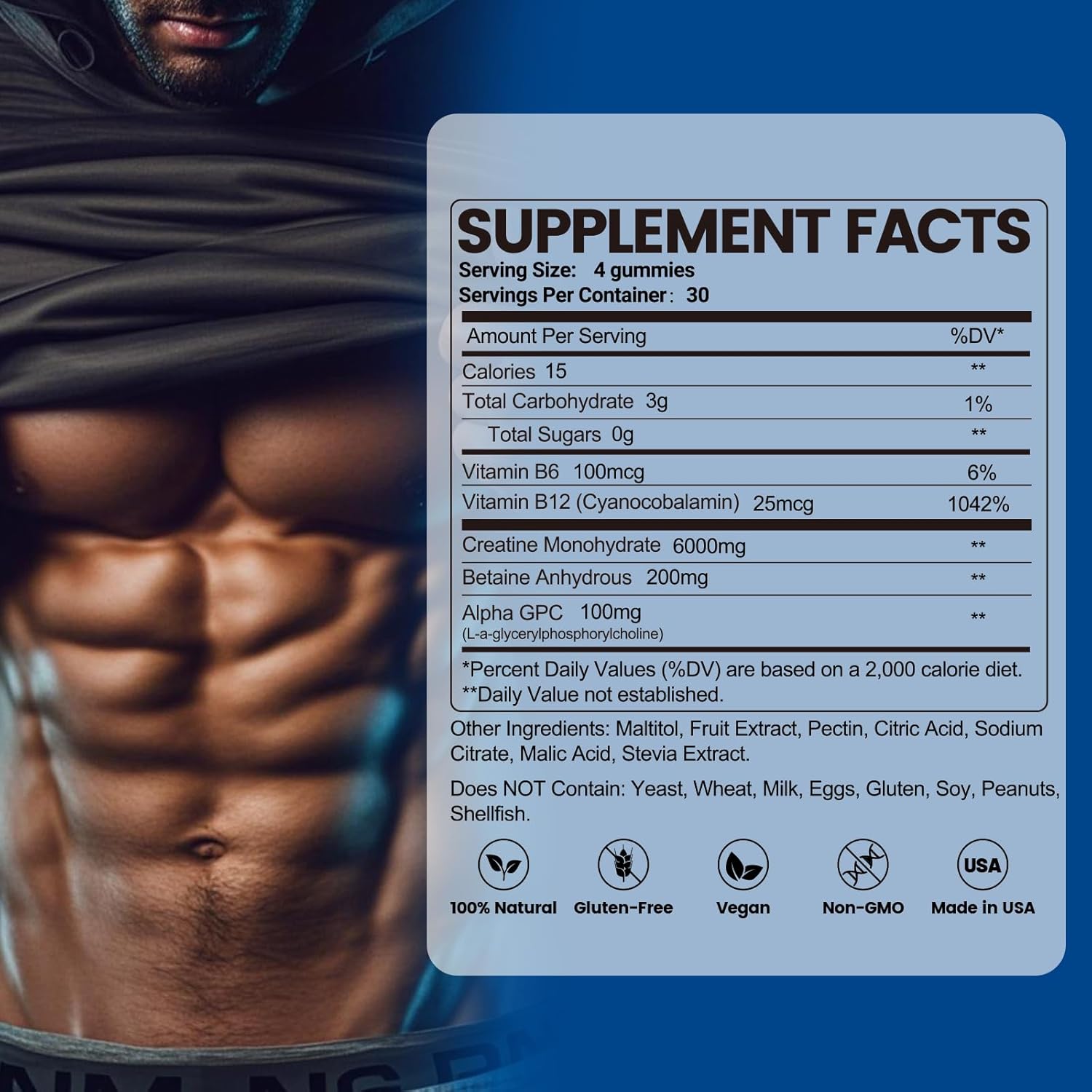
Look for the specific amount of creatine listed in the Supplement Facts panel.
For context, commonly used maintenance protocols for healthy adults often involve around 3–5 grams of creatine monohydrate per day. Whether a gummy serving provides that amount depends on its actual formulation.
2. How many gummies do you need?
A product may require several gummies to make up one serving. That is not necessarily a problem, but it affects convenience and how long a package lasts.
Check both the serving size and the number of servings per container before comparing prices.
3. What else is included?
Gummies may contain sweeteners, flavoring ingredients, gelling agents, and additional nutrients or functional ingredients.
These are not automatically bad. They simply make the formula more complex than a single-ingredient powder.
If you are monitoring sugar intake or have dietary restrictions, review the full ingredient list rather than relying on the front label.
Does the Gummy Format Affect Creatine Stability?
This is a particularly important point.
Creatine monohydrate is stable as a dry powder under appropriate storage conditions. Once dissolved in liquid, however, its stability can be affected by factors such as temperature, acidity, and storage time.
That is one reason it is generally better to mix creatine powder shortly before drinking it rather than leaving it in a prepared beverage for long periods.
Gummies are more complicated because they are manufactured products with their own moisture levels, processing conditions, and shelf-life requirements.
It would be inaccurate to say that all creatine gummies are unstable. It would also be inaccurate to assume that every gummy product retains its labeled creatine content equally well.
Manufacturing quality, formulation, packaging, and stability testing all matter.
When choosing a gummy, look for a manufacturer that provides clear ingredient information and appropriate quality controls. If available, ask whether the finished product has been tested to verify its creatine content through its stated shelf life.
Which Format Is Better for Everyday Use?
There is no universal winner. It depends on what makes a supplement practical for you.
Creatine powder may be the better fit if you:
-
Prefer a simple, single-ingredient formula.
-
Want more flexibility with serving size.
-
Are looking for a lower cost per gram.
-
Do not mind mixing powder into a drink.
Creatine gummies may be the better fit if you:
-
Prefer a chewable format.
-
Travel frequently or want something portable.
-
Dislike the texture of powdered supplements.
-
Find gummies easier to remember and take consistently.
One point deserves emphasis: convenience only helps if the product delivers an appropriate amount of actual creatine.
A gummy that tastes good but provides very little creatine per serving may not be a useful substitute for a properly dosed powder.
How to Compare the Price Fairly
Comparing the price of one tub of powder with one bag of gummies can be misleading.
Instead, calculate the cost per gram of creatine monohydrate.
You will need three details:
-
The price of the product.
-
The number of servings in the container.
-
The actual grams of creatine monohydrate per serving.
Divide the product price by the total grams of creatine monohydrate in the container. This gives you a much more useful comparison than looking at the package price alone.
For gummies, also consider how many pieces make up one serving. A container that looks large may contain fewer full servings than you expect.
What About inGreens Creatine Gummies?
For people who prefer a chewable format, inGreens offers Creatine Monohydrate Gummies in Mixed Berry flavor.
The product is presented as a multi-ingredient formula rather than a plain creatine powder. That makes it especially important to review the Supplement Facts panel and distinguish the total formula amount from the actual creatine monohydrate content.
Before choosing it, check the serving size, recommended daily directions, and exact amount of creatine monohydrate per serving.
You can find the product here:
Explore inGreens Creatine Monohydrate Gummies – Mixed Berry, 120 Count
So, Which One Should You Choose?
If your priority is the most established, straightforward, and economical format, creatine monohydrate powder is a sensible choice.
If convenience and taste are more important to your daily routine, gummies may be worth considering, provided the formula delivers a clearly disclosed amount of creatine and meets appropriate quality standards.
The evidence supporting creatine monohydrate is strong. The evidence does not establish that gummies are inherently better than powder, or that powder is automatically more effective when the actual creatine dose is equivalent.
Choose based on the ingredient, the amount, the quality of the product, and what you can realistically stick with.
A supplement routine should make your life easier, not give you another reason to skip it.
This article is for general educational purposes only and is not a substitute for individualized medical advice.