





Urolithin A Supplement Safety: What to Know Before Starting

Understanding Human Safety Research, Dosage, Potential Interactions, and What to Consider Before Adding Urolithin A to Your Routine.
Whenever a supplement starts getting attention, one of the first questions worth asking is a fairly simple one: What do we actually know about its safety?
Urolithin A is an interesting example. Researchers have been studying it for its potential relationship with mitochondrial health, cellular maintenance, and muscle function. The human research has produced some encouraging findings, and the ingredient has become increasingly visible in the healthy-aging supplement market.
But there's a difference between an ingredient showing a favorable safety profile in clinical trials and knowing exactly how it will affect every person who takes it.
If you're considering a Urolithin A supplement, especially one that combines several ingredients, there are a few things worth understanding before getting started.
What Does Human Research Say About Urolithin A Safety?
One of the earliest human studies investigating Urolithin A was published in Nature Medicine in 2019.
Researchers conducted a first-in-human clinical trial involving healthy older adults. The study examined both single doses and repeated daily supplementation over 28 days.
Participants received different amounts of Urolithin A, including 500 mg and 1,000 mg daily during the repeated-dose portion of the study.
The researchers reported a favorable safety profile and found that Urolithin A was well tolerated during the trial.
They also observed changes in certain biomarkers associated with mitochondrial function. These findings helped establish the foundation for subsequent human research.
A few years later, two additional randomized controlled trials provided more information.
A 2022 study published in JAMA Network Open involved 66 adults between 65 and 90 years old. Participants received either 1,000 mg of Urolithin A daily or a placebo for four months.
Researchers monitored adverse events, vital signs, blood chemistry, and other safety measurements.
No statistically significant differences in adverse events were observed between the Urolithin A and placebo groups. The researchers also reported no serious adverse events during the study.
Another trial, published in Cell Reports Medicine in 2022, investigated 500 mg and 1,000 mg daily in 88 middle-aged adults over 120 days.
The researchers found that Urolithin A was generally well tolerated, with no significant differences between the groups in the safety measurements they evaluated.
These studies are encouraging. However, they involved relatively small groups of generally healthy participants, and their intervention periods were limited.
You can review the original studies here:
- 2019 human safety study – Nature Medicine
- 2022 older-adult clinical trial – JAMA Network Open
- 2022 middle-aged adult clinical trial – Cell Reports Medicine
How Much Urolithin A Has Been Studied?
Dosage is another area where it's easy to become confused.
Different clinical studies have used different amounts of Urolithin A, depending on the population and research objectives.
For example:
| Research | Daily Amount | Duration |
|---|---|---|
| 2019 first-in-human study | 500 mg and 1,000 mg in repeated-dose groups | 28 days |
| 2022 older-adult trial | 1,000 mg | 4 months |
| 2022 middle-aged adult trial | 500 mg or 1,000 mg | 4 months |
A 2024 systematic review published in Ageing Research Reviews brought together five human studies involving 250 healthy adults.
The researchers examined Urolithin A doses ranging from 10 mg to 1,000 mg daily, with study durations between 28 days and four months.
Across the available studies, reported adverse events were generally mild or moderate and were not considered related to Urolithin A supplementation.
However, the review also highlighted an important limitation: none of the included studies followed participants after the supplementation period ended.
That means we have much less information about what happens with continuous use over several years.
It's also worth remembering that a dose used in a clinical trial is not automatically the right dose for every individual or every commercial supplement.
More research is needed to establish longer-term safety and understand how different formulations may behave.
Read the 2024 systematic review in Ageing Research Reviews.
Are There Side Effects to Be Aware Of?
Based on the published human studies, Urolithin A has generally shown good short-term tolerability in the populations investigated.
That doesn't mean everyone will respond in exactly the same way.
People can react differently to dietary supplements, and symptoms may be related to an individual ingredient, the overall formulation, other supplements being taken, or an unrelated health issue.
If you notice an unexpected reaction after starting a supplement, don't assume you need to push through it.
Stop taking the product and speak with a healthcare professional about what happened. Seek prompt medical attention if you experience symptoms of a serious allergic reaction or another urgent medical problem.
There is also a difference between an adverse event occurring during a clinical trial and an adverse event being caused by the ingredient being studied. Researchers consider this distinction when evaluating safety data.
This is why careful interpretation of clinical results matters.
What If You're Already Taking Prescription Medication?
This is particularly important when considering a multi-ingredient supplement.
Urolithin A is often discussed as an individual ingredient, but commercial formulas may combine it with other compounds that have their own pharmacological and nutritional considerations.
For example, CoQ10 is known to have a potential interaction with warfarin, a prescription anticoagulant. The NIH Office of Dietary Supplements discusses this interaction in its guidance on supplements and medications.
This is relevant when evaluating a formula that contains both Urolithin A and CoQ10.
It doesn't mean everyone taking a blood thinner must automatically avoid every CoQ10-containing product. It does mean that the combination should be reviewed by the healthcare professional managing the medication.
The same principle applies if you regularly take prescription medications, use several supplements, or have a medical condition that requires ongoing treatment.
Before starting something new, provide your doctor or pharmacist with the complete ingredient list and the amount of each ingredient per serving.
The National Center for Complementary and Integrative Health also recommends discussing all supplements and medications with healthcare providers to help identify potential interactions.
NIH guidance on supplement and medication interactions.
Who Should Be Especially Careful?
Some people should take an extra step before introducing a new supplement.
If any of the following applies to you, professional guidance is a sensible starting point:
- You take prescription medications, particularly anticoagulants or medications requiring careful dose monitoring.
- You have a chronic medical condition or are receiving ongoing medical treatment.
- You are preparing for surgery or another medical procedure.
- You are pregnant, breastfeeding, or planning to become pregnant.
- You already take several supplements and want to combine them into one daily formula.
There is limited Urolithin A-specific research in several of these populations. That doesn't establish that the ingredient is harmful to them, but it also doesn't provide enough evidence to assume that supplementation is appropriate.
A healthcare professional can consider your medical history, medications, and the complete formulation before advising you.
Understanding FDA Regulation of Dietary Supplements
There's one more thing worth understanding when shopping for supplements in the United States.
The FDA does not approve dietary supplements for safety and effectiveness before they are marketed in the same way it approves prescription drugs.
Under the Dietary Supplement Health and Education Act of 1994, manufacturers and distributors have the initial responsibility for ensuring that their products meet applicable safety, quality, and labeling requirements.
The FDA can take enforcement action against products that are adulterated, misbranded, or otherwise violate federal requirements.
Manufacturers must also follow applicable dietary supplement current Good Manufacturing Practice requirements.
This distinction is important because phrases such as "FDA approved" can sometimes be used misleadingly in supplement marketing.
A manufacturing facility's registration with the FDA is not the same as FDA approval of an individual supplement.
When evaluating a product, consider looking for:
- A complete ingredient list with amounts per serving.
- A clearly identified serving size.
- Manufacturer or distributor contact information.
- Lot numbers and expiration dates.
- Transparent quality-control and testing information.
- Evidence supporting the identity and purity of the ingredients.
Third-party testing can provide additional quality information when it is available, although certification and testing claims should always be checked rather than assumed.
You can learn more directly from the FDA's official Questions and Answers on Dietary Supplements.
A Closer Look at the inGreens Urolithin A Complex
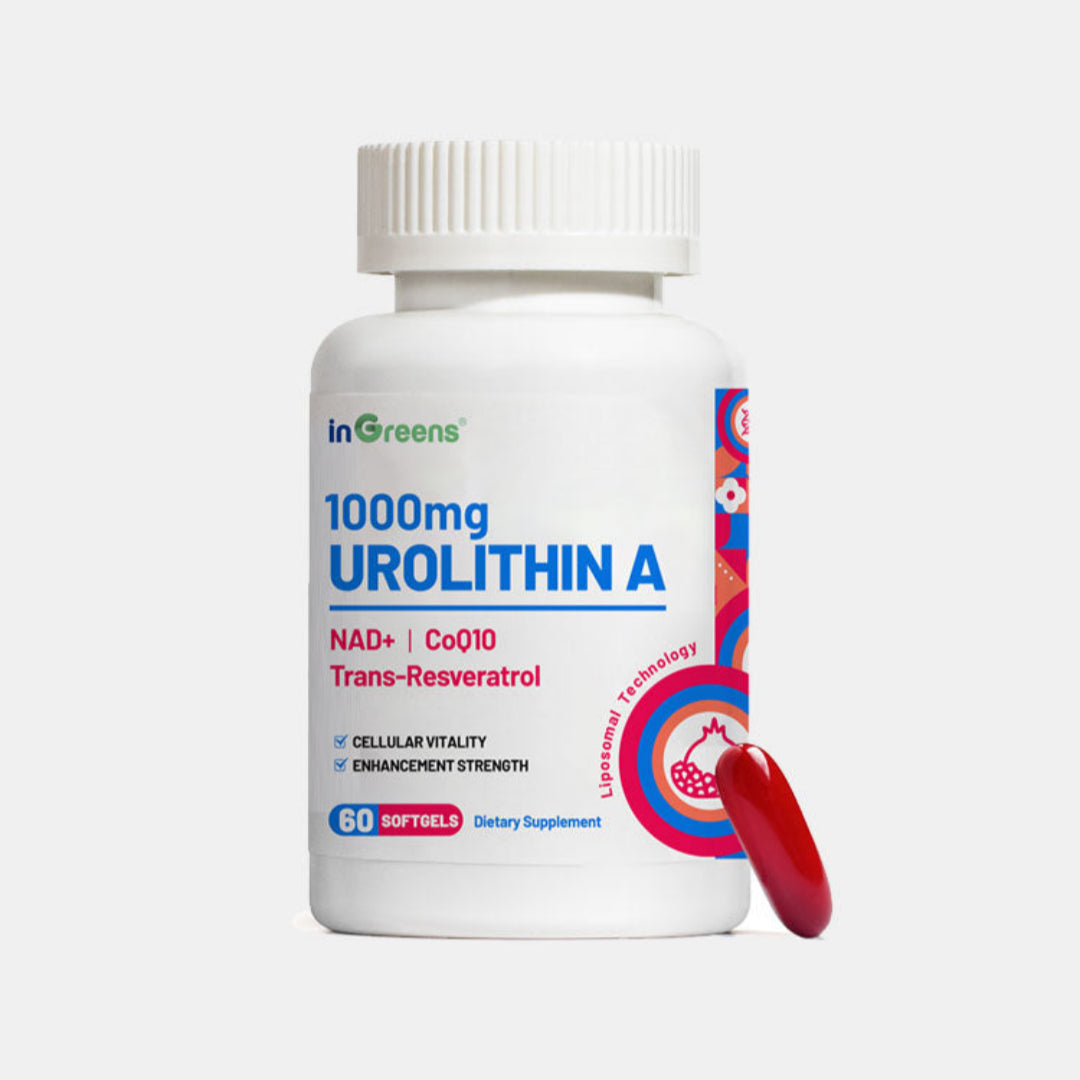
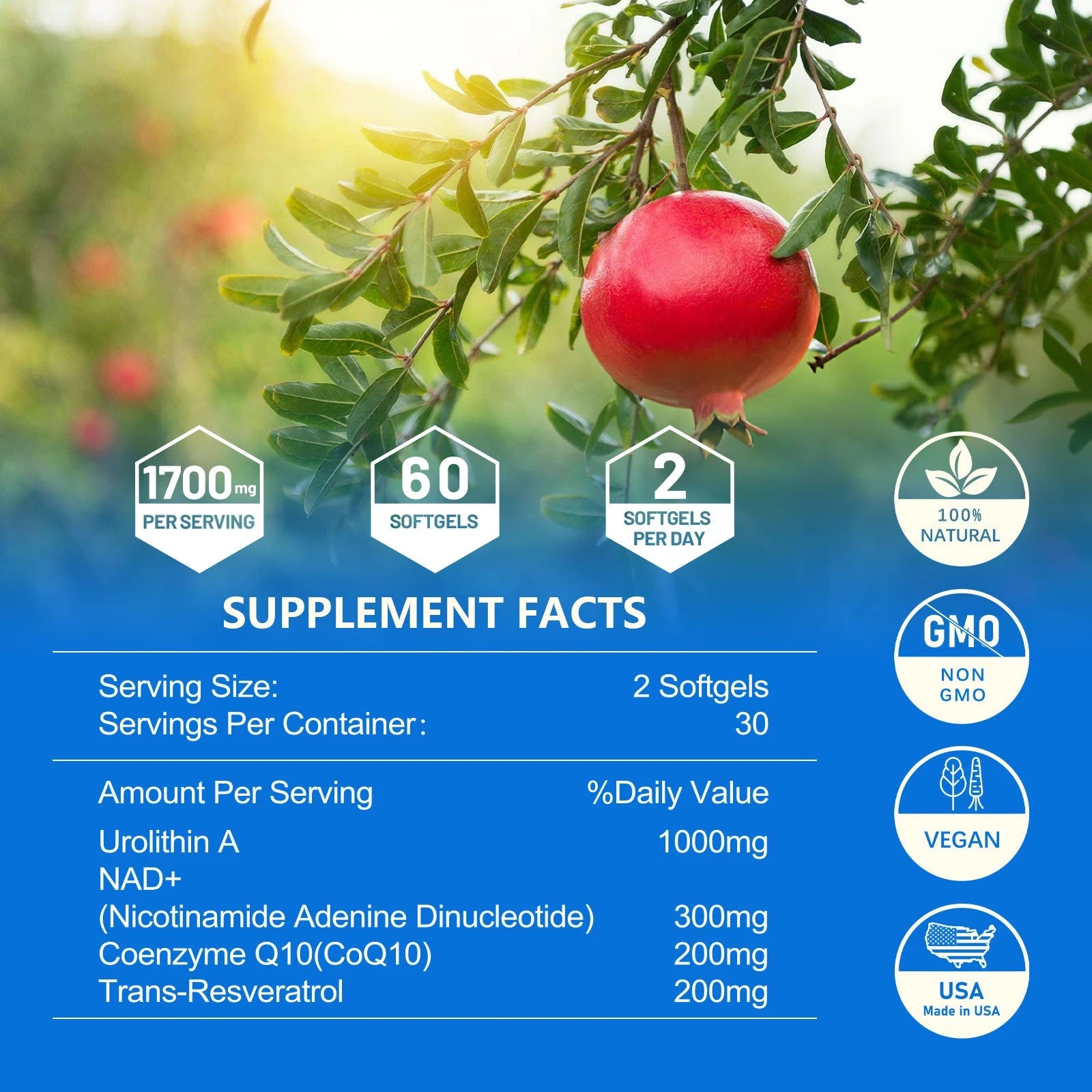
For people interested in exploring Urolithin A supplementation, the inGreens Urolithin A Complex combines four ingredients in one daily softgel formula.
According to the product label, each two-softgel serving contains:
| Ingredient | Amount Per Serving |
|---|---|
| Urolithin A | 1,000 mg |
| NAD+ | 300 mg |
| CoQ10 | 200 mg |
| Trans-Resveratrol | 200 mg |
The bottle contains 60 softgels, providing 30 servings.
The suggested use is two softgels daily, with or without food.
One detail deserves attention: the clinical safety studies discussed earlier primarily investigated Urolithin A as an individual ingredient. They do not establish the long-term safety or clinical effectiveness of this complete four-ingredient formula.
The additional ingredients should be considered when reviewing the product, particularly if you take prescription medications or already use other supplements.
For anyone considering this formula, reviewing the complete label with a healthcare professional is a reasonable step.
You can find the ingredient details and product information here:
Explore inGreens Urolithin A Complex
A More Thoughtful Approach to Supplementation
There's no need to approach every new supplement with fear, but a little patience can go a long way.
Urolithin A has a growing body of human research behind it, and the available short-term safety findings are encouraging. At the same time, the number of participants studied remains relatively small, and we still need longer follow-up periods.
If you're considering adding it to your routine, start by understanding the complete formula, reviewing your existing medications and supplements, and discussing any relevant health concerns with your healthcare professional.
Good supplementation decisions aren't just about finding an interesting ingredient. They're about making sure the product, the dose, and the overall routine make sense for the person taking it.